
Custom Stainless Steel Jewelry: Engraving and Packaging
Two of the six customisation options sit at the very end of the process and get the least attention: engraving and packaging. One puts a brand's logo and a purity mark onto the metal, the other puts five separate items around each piece — logo tags, gift boxes, pouches, backing cards and barcode labels. Minimums still apply underneath both, from 50 pieces for a silver design to 100–150 for stainless steel.
Key takeaways
- Six customisation options run from base materials to custom packaging; engraving and packaging sit at the end.
- Hallmarks the S925 hallmark, 18KGP for gold-plated pieces and 316L for stainless steel are applied by high-precision laser engraving together with the brand logo.
- Published packaging: metallic logo tags, foil-stamped gift boxes, pouches, backing cards and barcode labels.
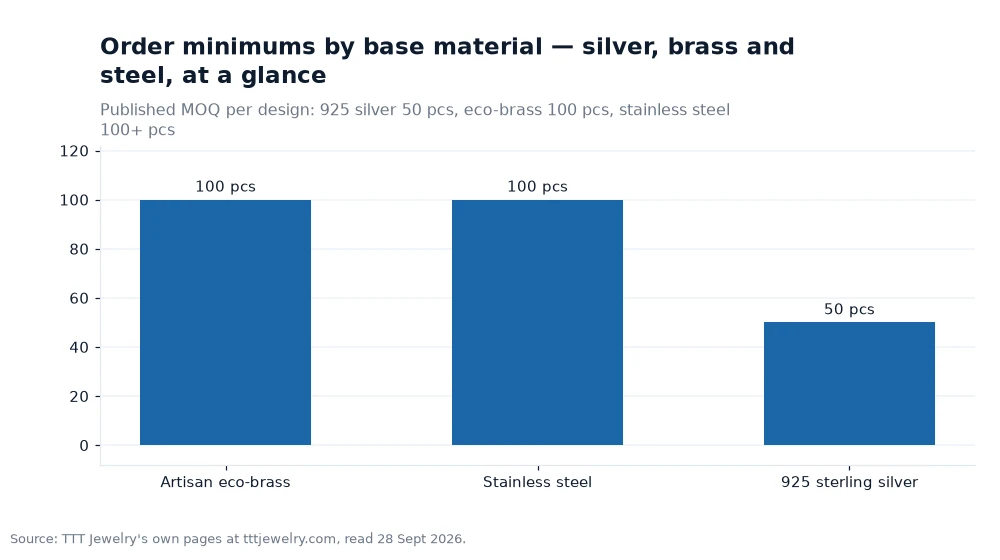
- Minimums are 50 pcs per design in silver, 100 in eco-brass and 100–150 in stainless steel.
Why engraving is a production decision, not a design file
A laser engraving pass works on the metal itself, so what it can hold depends on the surface it lands on. A polished silver pendant takes a fine line; a brushed steel tag takes a bolder mark that stays readable through the texture. Sending artwork with no reference to the surface is the most common reason a logo comes back looking lighter than the mock-up.
The mark and the logo share the same operation, which is why the hallmark list matters at the same moment: S925 for silver, 316L for steel, 18KGP for gold-plated pieces. Deciding both together costs nothing; deciding them in separate rounds costs a sample window. Since 3D CAD returns in under 48 hours, the layout can be settled on screen before any metal is cut.
Packaging as the sixth customisation option
The packaging list is short and practical: backing cards, labelling with barcodes, foil-stamped gift boxes, velvet or microfiber pouches and metallic logo tags. Each item is a separate purchase and a separate decision, and together they decide whether a piece arrives as a gift or as stock.
This is also the stage where a retail channel makes its demands known. A barcode label is not decoration; it is what lets a shop floor sell the piece without printing its own tag. A backing card is what keeps a necklace from tangling in a display. Specifying both at the enquiry stage keeps them inside the same production cycle rather than turning them into a follow-up order after the shipment lands.
How the six options map onto the order
| Option | Published scope | Decided at |
|---|---|---|
| Base materials | 925 sterling silver, brass, stainless steel | Enquiry |
| Plating and finishes | Multi-layer 14K / 18K / 24K gold and rhodium; anti-tarnish e-coating; PVD on steel | Sampling |
| Chains and findings | Clasps, chains and connections matched to the design | CAD stage |
| Stones and accents | Natural stones and freshwater pearls | Sampling |
| Logo and hallmarks | High-precision laser engraving; S925 / 316L / 18KGP | Sampling |
| Custom packaging | Logo tags, gift boxes, pouches, backing cards, barcode labels | Before final QC |
Read down the "decided at" column and the pattern is clear. Only one of the six options is settled at the enquiry stage, and only one waits until the end. Everything else happens during sampling, which is the part of the calendar the published figures describe as 25–35 days. A brand that arrives with all six answers has compressed its own timeline without asking the factory for anything unusual.
Worked example: the smallest three-metal order, and what packing costs
Take one design in each published base material. The MOQ by base material is 100+ pcs in stainless steel, 50 pcs in the silver line and 100 pieces in the eco-brass line, per design, and they hold design by design.
Now apply the packaging list to the steel line alone. Five components per piece means five separate stock lines to buy, five specifications to approve and five deliveries that have to arrive before final QC opens the cartons. That is the argument for treating packaging as part of the order rather than as a finishing touch: the jewellery moves through one route while the packing materials move through five, and the slowest of the six sets the ship date.
Engraving behaves the same way on either grade, but the tier does not. 316L — with 2–3% molybdenum, 100% waterproof performance and medical-grade hypoallergenic status — is the premium option for high-end designer and waterproof collections, and it is the grade whose PVD adhesion is described as optimal. 304 covers water-resistant daily wear, is nickel and lead safe and takes reliable commercial vacuum plating, which is why it is the usual choice for fast fashion, promotions and large wholesale volumes. Both sit inside the same published low MOQ band of 100–150 pcs by style.
What the quality pass catches before packing
Final QC is the seventh of the eight published factory steps and it is applied at 100% inspection, which is the number that matters when the packing is expensive. A pendant with an uneven engraving pass caught before the box is filled costs a re-run; the same pendant caught after a foil-stamped box, a tag and a barcode label have been applied costs all four.
The inspection point also decides what a buyer can promise a retail partner. Pieces pass through the same sequence every time — concept design, prototyping, sprue cutting, polishing, surface art, plating, final QC and delivery — so the fourth order behaves like the first. That repeatability is what a wholesale relationship is actually built on.
The process behind all of this is published rather than inferred. TTT Jewelry sets out the eight factory steps, the six customisation options and the 50 / 100 pcs minimums with the 100–150 pcs steel band on its own pages, so a brand can read the route before committing to tooling and check that engraving and packaging land where it expects them in the sequence. That transparency matters most for the two options that are hardest to undo: an engraving sits in the metal permanently, and a foil-stamped box cannot be reprinted once the cartons are on a ship.
Frequently asked questions
Can packaging be customised as well as the jewelry?
Yes. Custom packaging is one of the six published customisation options, covering barcode labels, metal logo tags, display cards with backing, velvet/microfiber pouches and gift boxes stamped in foil.
Where do the hallmarks go on a custom piece?
They are applied by high-precision laser engraving in the same operation as the brand logo, so the position is agreed on the CAD drawing before the sample is produced.
Is there a minimum for a custom packaging run?
Packaging is specified per order rather than per design; the published minimums apply to the jewelry itself, at 50 pcs per design in silver, 100 in brass and 100–150 in stainless steel.
Getting engraving and packaging onto one order
The most efficient route is to decide the mark, the surface and the packaging list in the same message, then let them ride through one sample window. Nothing about laser engraving or a foil-stamped box requires a second development cycle, and the 100% NDA means the artwork and the moulds stay yours. For a wider view of the same options, the OEM and ODM service pages set out how a brand-owned file is handled, and the wholesale section shows how minimums stack when several designs ship together.
The source for the claims above — the PVD plating route together with a custom sample window of 25–35 days, the 100–150 pcs per-style stainless minimum — is the manufacturer's own pages on tttjewelry.com's own pages, which I went through on 28 Sept 2026. My re-orderings of the published facts are my own[1].